Updated 15 June 2026. First published 26 July 2025.
Contract Harvesting Rates Australia 2026: Header, Chaser Bin and Harvest Contractor Costs
Australian Custom Harvesters' 2026 harvest rates guide lists Class 6-9 header rates from $680 to $950 per engine hour, excluding GST, with fuel supplied by the grower. Those rates are an Australia-wide benchmark valid from 1 February 2026, not a fixed quote for every paddock.
Use the figures below as a starting point for planning harvest work in NSW, QLD and other grain regions. Final quotes still depend on crop, yield, distance, field conditions, fuel terms, machine setup and whether extra gear such as chaser bins or trucks is included.
| Work type |
2026 benchmark |
Location and date |
Terms |
| Class 6 header |
$680 per engine hour |
Australia-wide ACH benchmark, valid from 1 Feb 2026 |
Ex GST, fuel supplied by grower |
| Class 7 header |
$780 per engine hour |
Australia-wide ACH benchmark, valid from 1 Feb 2026 |
Ex GST, fuel supplied by grower |
| Class 8 header |
$850 per engine hour |
Australia-wide ACH benchmark, valid from 1 Feb 2026 |
Ex GST, fuel supplied by grower |
| Class 9 header |
$950 per engine hour |
Australia-wide ACH benchmark, valid from 1 Feb 2026 |
Ex GST, fuel supplied by grower |
| Chaser bin, tractor and operator |
$300 per engine hour |
Australia-wide ACH benchmark, valid from 1 Feb 2026 |
Ex GST, fuel supplied by grower |
| Average crop tonne rate |
$30 per tonne |
Australia-wide ACH benchmark, valid from 1 Feb 2026 |
Ex GST, good average crop, good conditions |
Source: Australian Custom Harvesters, Harvest Rates, checked 15 June 2026. ACH rates are suggested rates only. Always confirm GST, fuel, travel, crop condition, paddock size, levies and any minimum charges before agreeing to work.
How to Use These Contract Harvesting Rates
The ACH figures are useful because they make the quote conversation less woolly. A farmer can check whether a header quote is in the right band for the machine class. A contractor can use the same benchmark to explain why a bigger machine, longer travel, difficult crop or poor paddock conditions may cost more.
The figures should not be copied into a job ad as a guaranteed price. The real quote still needs the crop type, expected yield, paddock size, distance between blocks, unload setup, fuel arrangement, operator requirements and whether the job includes chaser bins, trucks or extra support gear.
NSW and QLD Harvest Rate Context
Northern NSW and southern QLD jobs often start earlier than southern grain regions, which can make contractor availability tight when crops come off quickly. ABARES' June 2026 Australian Crop Report points to winter crop planting being affected by patchy autumn rainfall across Queensland and northern New South Wales[6]. That matters because short harvest windows and uneven crop conditions can change what a fair quote looks like.
For farmers, the practical move is to share enough detail early so contractors can quote properly. For contractors, the practical move is to state whether your quote follows the ACH hourly benchmark, a tonne rate, a hectare rate, or a blended rate for the full job.
What Changes the Final Quote?
The same Class 8 header can be fairly priced in different ways depending on the job. A clean, even wheat crop with good access is not the same as a lodged crop, scattered blocks, a wet paddock edge, a long travel leg or a job where the contractor needs to bring extra staff and support machinery.
The biggest quote variables are machine class, crop condition, expected tonnes per hectare, travel, fuel, chaser bin support, grain cartage, operator hours, accommodation and whether there is a minimum call-out charge. If the price is materially above or below the ACH benchmark, the quote should explain why.
Why More Booked Hours Matter for Contractors
Header ownership has heavy fixed costs: finance, depreciation, insurance, repairs, maintenance and transport all need to be covered before there is profit. More booked hours do not make a bad rate good, but they can spread fixed costs over more work.
A contractor charging the ACH Class 7 benchmark of $780 per engine hour, ex GST with fuel supplied by the grower, still needs enough seasonal hours to cover the ownership base. That is why filling gaps between local jobs matters. It is also why farmers should expect serious contractors to ask detailed questions before quoting.
Chart: Header Economics across operating hours
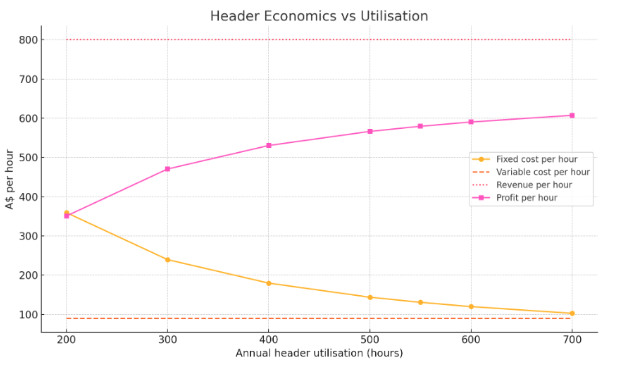
(A simple chart illustrating the change in fixed costs, revenue and margins by spreading costs over more work.)
Filling the Harvest Window in NSW and QLD
One practical way to add more jobs is to cover a wider region. On the east coast, harvest generally moves from Queensland into northern NSW, then further south as the season progresses. Contractors who can move between regions may be able to keep machinery working for longer, provided travel, staff and accommodation still make sense.
This is where rates and job detail need to meet. A rate that works for a local block may not cover a longer move, especially if the contractor is bringing a header, chaser bin, operator and support vehicle.
Use AgPages to Get Better Job Detail Before Quoting
AgPages helps farmers describe the job before the quote conversation starts: location, service needed, timing, crop and job notes. That makes it easier for contractors to decide whether the job fits their machinery, region and season calendar.
For farmers, that means fewer cold calls and a better chance of finding a contractor who actually services the area. For contractors, it means fewer vague leads and more job context before committing time to a quote.
Before You Lock in a Harvest Contractor
Ask what the quote includes, what it excludes and what changes the price. The most important details are GST, fuel, machine class, chaser bin support, travel, minimum hours, waiting time, crop condition and whether the contractor charges by hour, tonne, hectare or the full job.
If you are a contractor, put those details in writing. If you are a farmer, share enough job context to avoid a nasty surprise once the header is already on the road.
FAQ
What are contract harvesting rates in Australia in 2026?
Australian Custom Harvesters' 2026 guide lists Class 6-9 header rates from $680 to $950 per engine hour, excluding GST, with fuel supplied by the grower[5]. The guide is an Australia-wide benchmark valid from 1 February 2026. It is not a guaranteed quote for every job.
What is the 2026 contract harvesting rate in NSW?
There is no single NSW-only rate that suits every job. Use the Australian Custom Harvesters 2026 benchmark as the starting point: $680 per engine hour for a Class 6 header, $780 for Class 7, $850 for Class 8 and $950 for Class 9, ex GST with fuel supplied by the grower[5]. NSW quotes may move up or down depending on crop, region, travel and conditions.
Does the header rate include fuel?
The ACH 2026 header rates are listed with fuel supplied by the grower[5]. If a quote includes contractor-supplied fuel, ask for that to be written clearly because it changes the comparison.
What does chaser bin support cost in 2026?
Australian Custom Harvesters lists $300 per engine hour for a chaser bin, tractor and operator, excluding GST, with fuel supplied by the grower, valid from 1 February 2026[5]. Check whether the contractor's quote includes the bin, tractor, operator, fuel and travel.
Farmers: Post your job in minutes and get matched with verified contractors
Contractors: Get notified about real jobs that match your services and gear
Author:

Related Articles
Harvest season is fast-paced, high-stakes, and too often stressful. AgPages has officially launched to help change that.
Finding a reliable contract harvester is crucial for a smooth wheat harvest season. Learn how to verify credentials and connect with pre-vetted contractors.